Technology & image quality
AI in iris photography
Automation removes a lot of work from iris editing. It does not restore anything that is not in the capture — and with a biometric pattern, that distinction matters more than with almost any other subject.
Short answer
AI-assisted methods are strong in iris work where the task is recognition and repetition: finding the iris boundary and pupil, locating obstructions, isolating and preparing consistently. They become problematic where missing image information is meant to be replaced — generated iris structure is plausible but is not the structure of the photographed eye. Deciding what is acceptable stays with the photographer.
Two kinds of processing
Recognising methods
These analyse the image and return information: where the pupil sits, how the limbus runs, which areas the lid covers, where a reflection lies. They do not alter the image — they describe it.
They are uncontroversial and, for studios, the biggest practical gain, because they take over exactly the steps that repeat identically on every iris and still cost time.
Generating methods
These compute new image content: filling missing areas, 'sharpening' structure, raising resolution with invented detail. The result often looks convincing — but it shows patterns the method considers plausible, not the patterns of the photographed eye.
In a landscape that is a matter of taste. In an iris, whose pattern is individual and recognisable, it is a change of content.
Important
The working line is: restoring is fine where information exists but is darkened or low in contrast. Inventing begins where an area holds no detail at all.
Where automation genuinely helps
The gain is not that a machine does it better than an experienced retoucher. It is that it does the fiftieth iris the same way as the first — see the iris photography editing workflow.
- Determining pupil and iris boundary — the same step on every capture
- Isolation with a consistent edge falloff across all of a studio's images
- Detecting obstructions such as lashes, lid edges and reflections
- Lifting local structure within defined limits
- Output at a uniform size and format
- Automatic checking of each version against recurring failure patterns
Where the limits are
Four situations remain hard even with good methods: clipped reflections with no residual detail, soft captures, dense lash bands over the upper iris, and irises largely covered by the lid.
In all four the information is absent. A method can fill the gap — with invented structure. The realistic options are to re-shoot or to accept the limitation. Details in reflections in iris photography.
| Situation | Automated handling | Assessment |
|---|---|---|
| Shadowed area | Brighten, lift contrast | Restoring detail that exists |
| Narrow lash over structure | Replace from surroundings | Acceptable over small areas |
| Clipped reflection | Fill the area generatively | Invented structure — disclose it |
| Soft capture | Add detail generatively | Creates patterns that were never photographed |
| Upscale to a larger format | Interpolation | Larger, not more detailed |
Quality control stays necessary
Automated methods rarely fail loudly. They deliver a result that looks right at first glance, with the flaw in a place that does not show in a small preview: the edge, the pupil transition, the upper half of the iris.
So every automated pipeline needs a check. The sensible combination is an automatic check against fixed criteria plus a short visual pass at 100 percent.
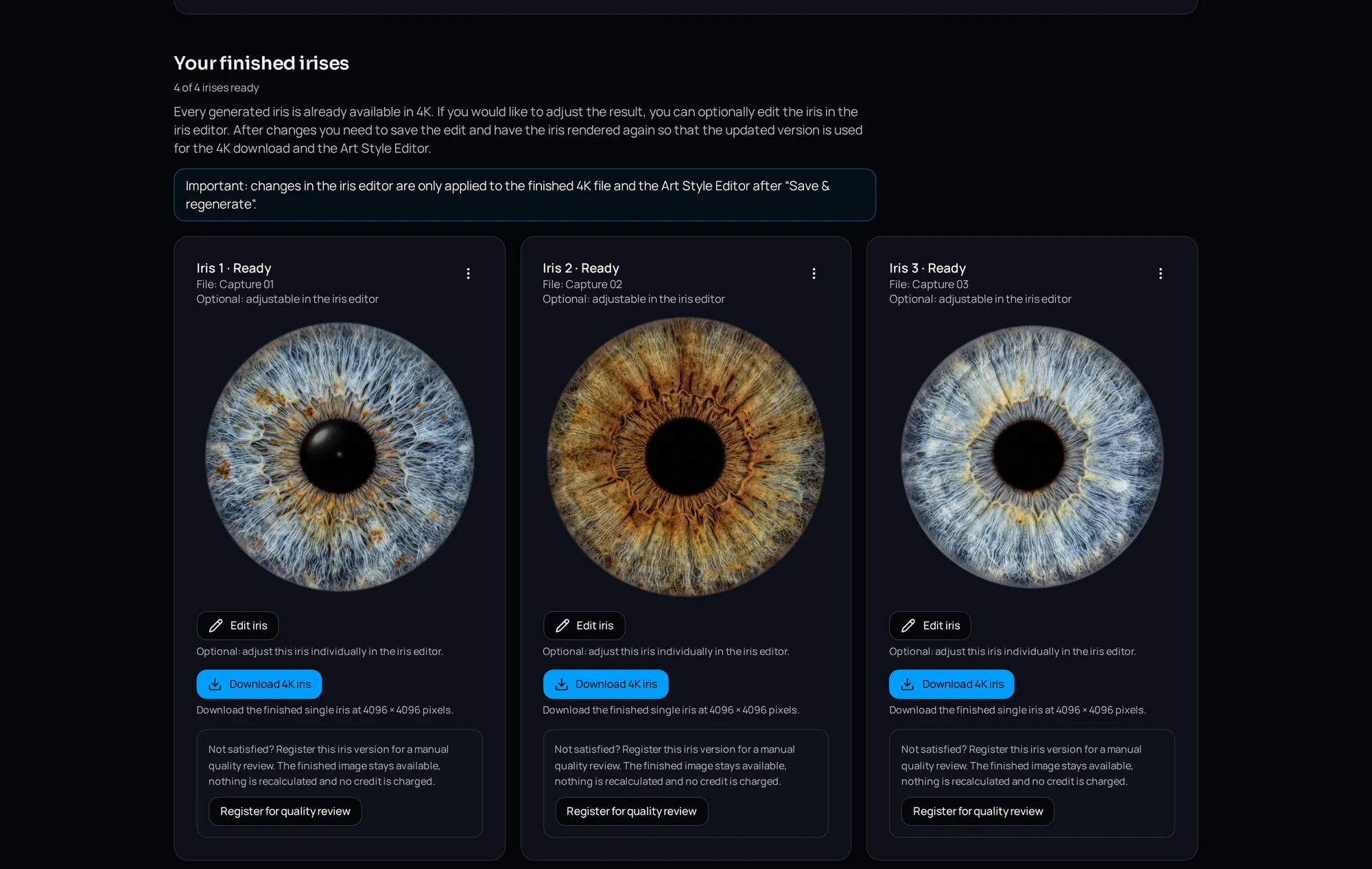
IRISORA checks every generated version against fixed criteria — among them circularity of the iris boundary, coverage of the iris area, and lid or foreign regions remaining inside the circle — and reports anomalies instead of smoothing them away.
Quality check
Inspect automated results in the same three places every time: iris rim, pupil transition, upper half. That is where over 90 percent of anomalies appear.
What stays with the photographer
What follows a rule can be automated. What requires a judgement cannot: which capture gets delivered, how natural or designed the colour should be, whether a lash at the edge stays, how the image is composed, and whether a capture is good enough for the requested format.
Those decisions are what separates one studio from another, and they remain regardless of how good the technical methods become.
Being straightforward with clients
Clients increasingly ask whether their image was 'made with AI'. A clear answer helps more than an evasive one: the capture comes from the camera, the preparation — isolation, structure, colour — runs automatically, and anything designed is named as designed.
If structure was added somewhere because the capture lacked it, that belongs in the answer too. It costs less trust than explaining it afterwards.
Common mistake
'AI-enhanced' as a label helps nobody. It sounds like added value while leaving open whether the delivered pattern is the pattern of the photographed eye.
Frequently asked questions
- Can AI rescue a soft iris capture?
- It can produce a sharper-looking image by adding detail, but that detail does not come from the photographed eye. For an image meant to show an individual iris pattern, a new capture is the only reliable route.
- Is automatic isolation as good as manual masking?
- On regular captures it produces more consistent results than manual work, because it does not depend on the day. On heavily occluded or soft captures, manual control remains superior.
- Does automated editing change the eye colour?
- It can, if saturation and contrast are raised indiscriminately. What to watch for is in [keeping natural iris colours](/wissen/natuerliche-irisfarben).
Related reading
Test automation with a check attached
See which steps run automatically and where the workflow reports an anomaly. Five free edits, no base fee.
5 free iris edits included